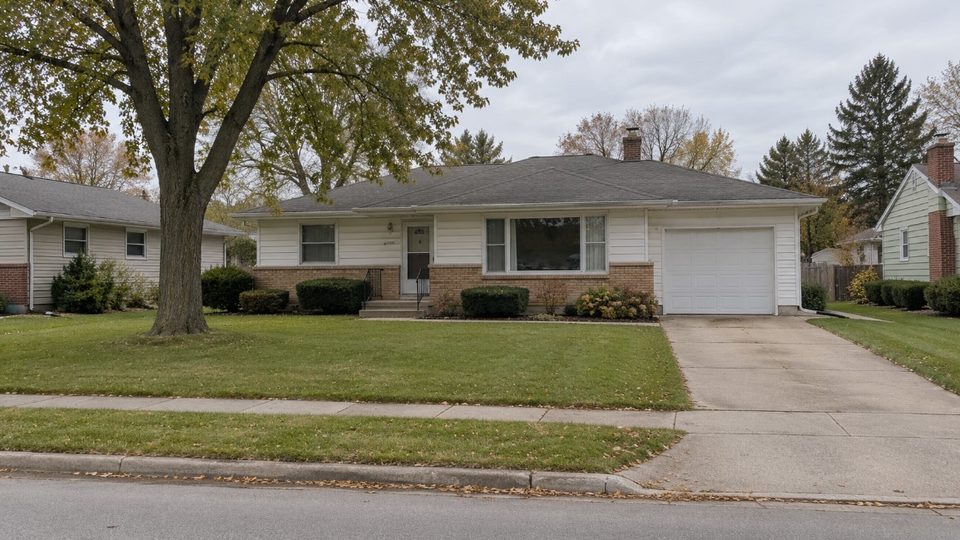
Split-Levels, Ranches and the Room That Is Half Underground
Glen Oaks is postwar and later, and a substantial share of it is split-level. That matters more than it sounds, because a split-level does something no other house type does: it puts finished living space against the ground on one side, with a full-height window wall on the other.
The result is a room with the moisture exposure of a basement and the finishes of a living room. The lower level is carpeted, furnished and occupied, and one or two of its walls are below grade against soil that is cold all year and wet every spring. When a problem develops there it is discovered late, because nobody expects the family room to behave like a basement.
What goes wrong in that wall
Usually the same assembly as everywhere else in the county — studs against the block, batts, paper-faced board — but built as part of the original construction rather than added later, which means the owner has no reason to suspect it. Add carpet laid directly over a slab with no insulation or vapor barrier under it, and the coldest surface in the house is also the one with the most organic material on it.
Serving Glen Oaks, WI
Call and tell us what is happening in your Glen Oaks property. A specialist will talk it through with you — free, and with no obligation.
(608) 724-1919Free phone consultation.
Attic Ventilation That Was Never Balanced
The second recurring call. These houses have low-pitch roofs and modest original ventilation, and two things have usually happened since: insulation has been topped up at some point, burying the soffit intakes, and a ridge vent has been added during a re-roof with nothing left to feed it. Air stops moving through the roof space, the deck runs cold and damp through the winter, and the sheathing stains.
The order of correction matters. Air seal the ceiling plane first, then install baffles so the soffits stay clear, then insulate to depth. Adding depth without doing the first two makes the attic colder while the same moist air keeps arriving, which increases the condensation rather than reducing it.
Crawl Spaces Under Additions
Rear additions, sunrooms and enclosed porches on these houses frequently sit over a crawl space rather than a basement, and those crawls are almost always vented to the outside. In a southern Wisconsin July that makes them wetter, not drier — outdoor air at 85°F and 70 percent humidity meets framing sitting in the low 60s and condenses on it. See crawl space mold removal for the correction.
Humidifiers Left Running Into Spring
Whole-house humidifiers on the furnace are common in this housing and are frequently left at a winter setting far too long. The evidence shows up as condensation on the inside of windows on cold mornings, damp in north-facing exterior corners, and growth behind furniture standing against outside walls. If you can see water on the glass, the humidistat is set too high for the outdoor temperature — and the same moisture is condensing inside the wall cavities where you cannot see it.
What Works Here
- Treat the split-level lower level as a basement, because that is what one of its walls is
- A hygrometer in the lower level, and a dehumidifier if it reads above 55 percent
- Humidistat turned down through the winter and switched off by March
- Air seal the ceiling plane before adding attic insulation
- Baffles to keep the soffit intakes clear
- Close and insulate crawl space vents, seal the ground
- No carpet laid directly on an uninsulated slab
What We Get Called About Most in Glen Oaks
Ranked by how often it comes up, and tied to the buildings that are actually here rather than to mold in general.
- Finished lower levels in split-level and ranch housingGlen Oaks is postwar and later, and a good share of it is split-level, which puts finished living space against ground on one side. That gives a room the moisture exposure of a basement with the finishes of a living room.
- Attic ventilation that was never balancedRidge vents added without adequate soffit intake, or soffits blocked when the insulation was topped up. Air stops moving, the sheathing runs cold and damp all winter.
- Crawl spaces under additionsRear additions over crawl spaces, vented to the outside in a climate where outside air in summer is wetter than the space it is ventilating.
- Humidifiers left running into springWhole-house humidifiers on the furnace are common here and are frequently left at a winter setting far too long. The condensation shows first on north-facing exterior corners.
Neighborhoods and Sections We Cover in Glen Oaks
Mold Services Available in Glen Oaks
Mold Inspection
Thermal imaging and moisture metering to find the source before anything is opened up.
Basement Mold Removal
The dominant mold problem in Glen Oaks — finished basement walls, limestone and block foundations, and sump failures.
Black Mold Removal
Full containment for water-damage indicator species, plus finding the sustained water source that let it establish.
Attic Mold Removal
Sheathing and rafter growth traced back to ventilation, bath fans or ice damming.
Water Damage & Flood Mold
Frozen and burst lines, sump failures and Rock River flooding — the 24 to 48 hour response window.
Clearance Testing
Independent verification by someone who did not perform the remediation.
What Mold Work Costs in Glen Oaks
General market ranges for south-central Wisconsin, listed for the situations that actually come up in Glen Oaks. These are planning figures rather than quotes — nobody can price a job they have not seen, and what moves a number most is the size of the wet area rather than the stained area. The full cost guide explains what drives each one up or down.
| Work | Typical range | Notes |
|---|---|---|
| Mold inspection with thermal imaging and moisture metering | $250–$600 | Most projects should start here |
| Finished basement — wall removal, drying, clearance | $4,000–$12,000 | Excluding reconstruction |
| Attic remediation with cleaning, treatment and re-insulation | $2,800–$7,500 | Ventilation correction usually extra |
| HVAC coil, plenum and duct cleaning | $600–$1,800 | Where the air handler is distributing the problem |
| Crawl space remediation with encapsulation | $3,500–$11,000 | Vapor barrier, sealing, dehumidification |
| Independent post-remediation clearance testing | $400–$900 | Should not be the same firm that did the work |
Prices shown are examples only. For an accurate quote for your specific situation, call (608) 724-1919 — free consultation with a specialist.
Mold FAQ — Glen Oaks, WI
That is the normal way a split-level lower level tells you something. The smell is coming from the back of the finished wall or from under the carpet, neither of which you can see. Put a hygrometer down there for a week; above 55 percent through the summer is a finding on its own. Then check the carpet at the wall edge and run a moisture meter along the bottom two feet of the drywall. Those three steps cost almost nothing and usually locate it.
On the below-grade side, yes, and treating it as a living room is what causes problems. That wall is in contact with soil that sits in the low 50s all year and is wet every spring, so it behaves exactly like a basement wall — it just happens to have a sofa against it. The practical consequence is that it needs basement-grade moisture control: humidity managed year-round, and if it is ever rebuilt, rigid foam against the masonry rather than studs against it.
Almost certainly because the insulation buried the soffit intakes. Ventilation depends on air entering low at the eaves and leaving high at the ridge; block the intake and the ridge vent has nothing to draw. Meanwhile the extra depth keeps the roof deck colder, so the same moist air arriving from the house condenses more readily. The fix is baffles at every rafter bay to hold the intake open, plus air sealing the ceiling plane so less moisture arrives in the first place.
Lower than most are set, and it should track the outdoor temperature. Around 30 to 35 percent when it is 0 to 20°F outside, dropping to 25 to 30 percent in a deep cold snap. Switch it off entirely once the weather turns in spring. Your windows are the gauge: persistent condensation on the inside of the glass on a cold morning means the setting is too high, and the same water is condensing inside the walls.
If the finished wall has to come out, it is priced like a finished basement: roughly $4,000 to $12,000 for remediation excluding reconstruction, scaled to how much of the below-grade perimeter is affected. If it is caught as a humidity problem before growth establishes, the answer can be a dehumidifier and some air sealing for a few hundred dollars. The gap between those two outcomes is entirely about how early it is found.