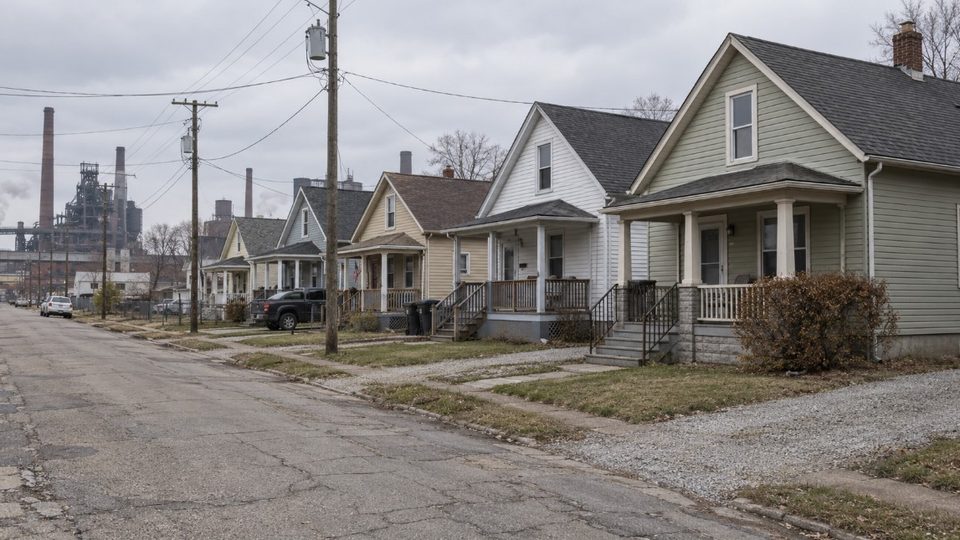
Rural Housing on Private Services
Orfordville and the surrounding townships are rural, and that changes the moisture picture in specific ways. Wells, septic systems and pressure tanks are all in or under the building, all capable of a slow leak, and all in a part of the house that is visited when something needs doing rather than routinely.
The characteristic rural finding is a moisture source that has been running quietly for a long time and was never dramatic enough to notice. A weeping fitting, a failing pressure switch, a softener discharge, or condensation on a cold water line above a stored pile of cardboard. None of them floods anything; all of them keep a corner of a basement permanently damp.
Two of those are worth checking against the seasonal pattern before assuming plumbing. If the damp is worst in July it is condensation on cold masonry rather than a leak, and if it arrives with the spring thaw it is meltwater on frozen ground. A constant damp patch in one spot, year round, is the one that points at a fitting.
Serving Orfordville, WI
Call and tell us what is happening in your Orfordville property. A specialist will talk it through with you — free, and with no obligation.
(608) 724-1919Free phone consultation.
Crawl Spaces and Partial Basements
Frequently a crawl under an older core with a poured basement under a later addition, or the reverse. The crawl is vented, the vents are open, and the ground underneath is bare. In a southern Wisconsin July that combination makes the space wetter rather than drier, because outdoor air at high humidity meets framing sitting in the low 60s.
Sealing the ground is the single biggest change available, and it is not expensive relative to the effect. Close and insulate the vents afterwards, not before.
Farm Outbuildings Converted to Habitable Use
Common out here, and consistently underestimated. A building with a slab poured without a vapor barrier, or with an earth floor, transmits ground moisture continuously. Insulating and finishing it puts organic material in the path of a permanent source. It can be done, but the floor has to be addressed first — a new slab with a barrier under it, or a floating assembly with a vapor barrier and rigid foam over the existing floor.
Deep Frost and Shallow Services
Frost reaches well below the depth people expect in this part of Wisconsin, and rural service runs are the ones most likely to be shallow, or to pass through an unheated crawl or outbuilding. A split line in a building nobody visits daily can run for a very long time. The combination of a cold week and an absent owner is how most of these start.
What We Get Called About Most in Orfordville
Ranked by how often it comes up, and tied to the buildings that are actually here rather than to mold in general.
- Rural housing on private servicesWells, septic and pressure tanks, all in the basement, all capable of a slow leak that goes unnoticed. The first sign is usually a smell rather than a stain.
- Crawl spaces and partial basementsFrequently a crawl under an older core with a poured basement under a later addition. The crawl is vented, the vents are open, and in July that makes it wetter, not drier.
- Farm outbuildings converted to habitable useSlab or earth floors with no vapor barrier, insulated after the fact and finished with materials that hold water.
- Deep frost and shallow servicesFrost reaches well below the depth people expect here, and lines that run shallow through an unheated space are the ones that split.
Neighborhoods and Sections We Cover in Orfordville
Mold Services Available in Orfordville
Mold Inspection
Thermal imaging and moisture metering to find the source before anything is opened up.
Basement Mold Removal
The dominant mold problem in Orfordville — finished basement walls, limestone and block foundations, and sump failures.
Black Mold Removal
Full containment for water-damage indicator species, plus finding the sustained water source that let it establish.
Attic Mold Removal
Sheathing and rafter growth traced back to ventilation, bath fans or ice damming.
Water Damage & Flood Mold
Frozen and burst lines, sump failures and Rock River flooding — the 24 to 48 hour response window.
Clearance Testing
Independent verification by someone who did not perform the remediation.
What Mold Work Costs in Orfordville
General market ranges for south-central Wisconsin, listed for the situations that actually come up in Orfordville. These are planning figures rather than quotes — nobody can price a job they have not seen, and what moves a number most is the size of the wet area rather than the stained area. The full cost guide explains what drives each one up or down.
| Work | Typical range | Notes |
|---|---|---|
| Mold inspection with thermal imaging and moisture metering | $250–$600 | Most projects should start here |
| Unfinished basement clean, treat and dehumidify | $1,200–$3,500 | No finishes to remove |
| Crawl space remediation with encapsulation | $3,500–$11,000 | Vapor barrier, sealing, dehumidification |
| Small contained area — one wall section, a closet, behind a water heater | $500–$1,500 | Under roughly 10–30 sq ft |
| Rim joist remediation and air sealing | $800–$2,500 | The coldest wood in the building |
| Independent post-remediation clearance testing | $400–$900 | Should not be the same firm that did the work |
Prices shown are examples only. For an accurate quote for your specific situation, call (608) 724-1919 — free consultation with a specialist.
Mold FAQ — Orfordville, WI
Look for a source that evaporates as fast as it arrives, which is the classic rural finding. Check the pressure tank and every fitting, the softener discharge, the water heater base, and any cold line running above stored material. A sheet of dry cardboard left under a suspect fitting overnight will show what your eyes miss. Also check whether the crawl space, if there is one, is feeding the basement — air moves from there upward.
It is the highest-value thing available in a rural property with a crawl. Bare earth transmits a surprising quantity of moisture, and a heavy reinforced vapor barrier over it, taped at the seams and turned up the walls, removes most of that at modest cost. Do that before closing the vents rather than after, so you are not trapping moisture that is still coming out of the ground.
The floor, nearly always. A slab poured decades ago without a vapor barrier, or bare earth, is a permanent moisture source, and everything you build on top of it — insulation, framing, flooring — sits in the path. The options are a new slab with a barrier under it, or a floating floor assembly with a vapor barrier and rigid foam above the existing one. Also plan roof ventilation, because agricultural buildings essentially never have any.
Pipes first, in every exterior wall and every unheated space, for splits that may have run undetected. Then the crawl and basement for standing water and staining, the rim joist, behind every appliance, and the attic for condensation staining from a cold but humid house. Put a hygrometer in the basement for a couple of weeks before deciding anything — a winter without heating or dehumidification leaves a signature a single visit can miss.