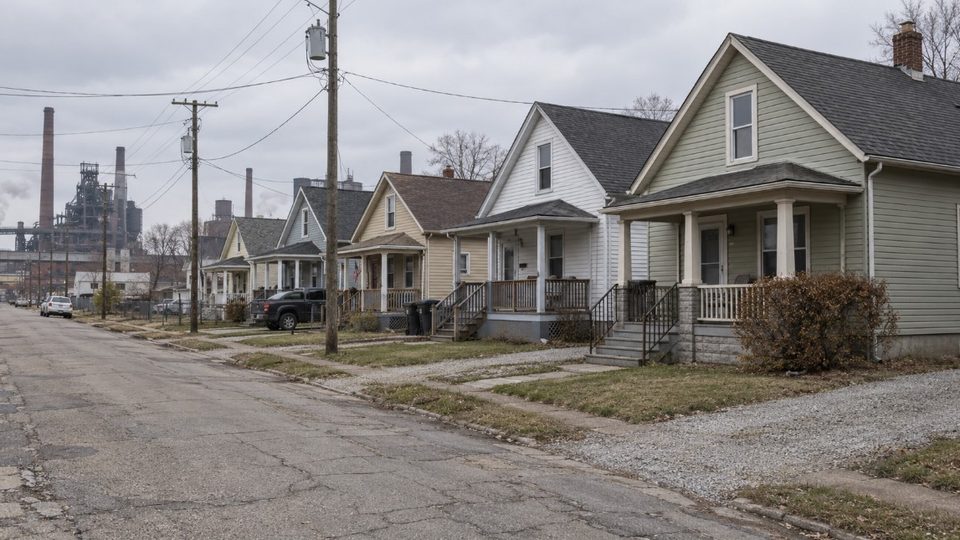
One District, Five Eras of Housing
The east side is the hardest part of Janesville to generalize about, because it runs from nineteenth-century worker housing near the old industrial corridor through to postwar subdivisions on the outer edge. Two houses on adjacent streets can fail in opposite directions.
That makes the first question here always the same: when was the building put up? More than the symptom, more than the room, more than the season, the age of the house determines what is most likely happening. A pre-1900 house with a stone cellar and a 1965 ranch with block walls need different answers to the same complaint.
| Era | Most likely problem |
|---|---|
| Pre-1900 | Rising damp through uncoated stone; balloon framing carrying cellar air upstairs |
| 1900–1940 | Shallow footings, grading, rim joist condensation; later basement finishing on a cold wall |
| 1945–1975 | Finished basements, bath fans into attics, original air handlers |
| 1975–2000 | Same finished-basement assembly at larger scale; sump systems now aging |
| 2000+ | Tight envelope with insufficient ventilation; humidity on cold interior surfaces |
Serving East Side, WI
Call and tell us what is happening in your East Side property. A specialist will talk it through with you — free, and with no obligation.
(608) 724-1919Free phone consultation.
The Houses That Were Underheated or Empty
This side of the city carried a significant share of the disruption after the assembly plant closed at the end of 2008, and a house that was kept just above freezing through a winter, or stood empty between owners, develops problems that a lived-in house does not.
The mechanism is straightforward once it is named. Heating a house to 50°F rather than 68°F means every surface is colder, so the dew point is reached more easily. Nobody is running extract fans, opening doors, or moving air. Nobody is running a dehumidifier. Nobody notices a slow leak. And in a property that is genuinely unheated, pipes freeze and split, and the water runs for days or weeks before anybody arrives.
If you are buying, renting out, or taking over a property that has been through that, it is worth mentioning at the start of a call — it changes what is worth checking first. See what a winter at 50 degrees does to an empty house.
Older Basements With Later Finishing
The east side version of the county-wide problem, with one aggravating factor: the finishing was frequently built onto stone or early block rather than modern poured concrete. That wall is colder, wetter and rougher than the block in a postwar subdivision, so the assembly behind it fails faster and the extent tends to be larger when it is found.
Radon Before You Finish Anything
Rock County is an EPA Radon Zone 1 county, roughly half of homes tested here come back at or above the action level, and three Janesville ZIP codes are among the highest in the state. Radon and water vapor use the same routes into a basement — the slab-to-wall joint, cracks, the sump pit. If you are opening a basement up or planning to finish one, testing first costs very little and changes what you should build. Doing it afterwards means opening the work back up.
What Works Here
- Establish the build era before anything else — it narrows the problem fastest
- For pre-1940 houses: keep the cellar vapor-open and control humidity mechanically
- For postwar: check behind the finished wall, and trace the exhaust ducts
- For any property that stood empty or underheated: assume nothing, check the pipes and the pattern
- Rim joist checked and air sealed
- Radon tested before a basement is finished
What We Get Called About Most in East Side
Ranked by how often it comes up, and tied to the buildings that are actually here rather than to mold in general.
- A wide mix of housing ages in one districtThe east side runs from nineteenth-century worker housing near the old industrial corridor through to postwar subdivisions, so the first useful question here is always the age of the building rather than the symptom. A 1890s house and a 1960s ranch on adjacent streets fail in opposite directions.
- Houses that were underheated or empty for a periodThis side of the city carried a lot of the disruption after the assembly plant closed in 2008, and a house kept just above freezing for a winter, or empty between owners, develops problems a lived-in house does not. Cold surfaces, no air movement and no dehumidification is the full recipe.
- Older basements with later finishingThe same concealed-wall assembly as elsewhere, but often built onto stone or early block rather than modern poured concrete, which makes the wall behind it colder and wetter.
- Rim joist and sill condensationDeep frost, an uninsulated band joist and warm indoor air is the standard Wisconsin combination, and it is invisible unless somebody pulls the insulation back.
- Radon testing before finishing a basementWorth doing before the walls go up rather than after. The same slab joints and sump pit carry both radon and water vapor.
Neighborhoods and Sections We Cover in East Side
Mold Services Available in East Side
Mold Inspection
Thermal imaging and moisture metering to find the source before anything is opened up.
Basement Mold Removal
The dominant mold problem in East Side — finished basement walls, limestone and block foundations, and sump failures.
Black Mold Removal
Full containment for water-damage indicator species, plus finding the sustained water source that let it establish.
Attic Mold Removal
Sheathing and rafter growth traced back to ventilation, bath fans or ice damming.
Water Damage & Flood Mold
Frozen and burst lines, sump failures and Rock River flooding — the 24 to 48 hour response window.
Clearance Testing
Independent verification by someone who did not perform the remediation.
What Mold Work Costs in East Side
General market ranges for south-central Wisconsin, listed for the situations that actually come up in East Side. These are planning figures rather than quotes — nobody can price a job they have not seen, and what moves a number most is the size of the wet area rather than the stained area. The full cost guide explains what drives each one up or down.
| Work | Typical range | Notes |
|---|---|---|
| Mold inspection with thermal imaging and moisture metering | $250–$600 | Most projects should start here |
| Unfinished basement clean, treat and dehumidify | $1,200–$3,500 | No finishes to remove |
| Finished basement — wall removal, drying, clearance | $4,000–$12,000 | Excluding reconstruction |
| Small contained area — one wall section, a closet, behind a water heater | $500–$1,500 | Under roughly 10–30 sq ft |
| Rim joist remediation and air sealing | $800–$2,500 | The coldest wood in the building |
| Radon test, then mitigation if the result warrants it | $150 test · $900–$2,200 system | Rock County is an EPA Zone 1 county |
| Independent post-remediation clearance testing | $400–$900 | Should not be the same firm that did the work |
Prices shown are examples only. For an accurate quote for your specific situation, call (608) 724-1919 — free consultation with a specialist.
Mold FAQ — East Side, WI
The Rock County property records are the authoritative source and are searchable by address. The building itself also tells you: balloon framing and a stone cellar means pre-1900 or close to it; a poured concrete basement with steel beams means postwar; block walls with a sump pit built in means later still. If you are not sure, say what you can see on the call — describing the foundation material and the joist arrangement usually places a house within a couple of decades.
In this order. Every plumbing run in an exterior wall or an unheated space, for splits that were never found. The basement and any crawl space for standing water and staining. The rim joist. Behind and under any appliance. The attic, for condensation staining on the sheathing from a house that was cold but still humid. And put a hygrometer in the basement for two weeks before you decide anything — two winters without dehumidification leaves a signature that a single visit can miss.
Drier, yes. Dry in the modern sense, no, and pursuing that is what damages these buildings. A stone cellar with no damp-proof course is permanently in capillary contact with the soil, and the wall stays sound by letting that moisture evaporate from the inside face. The workable approach is to keep the wall vapor-open, correct everything happening outside the building — gutters, downspouts, grading — and run a dehumidifier to manage the air. Sealing the wall relocates the problem into the stone.
Not worse, more varied. The older housing near the industrial corridor has more of the problems that come with age and economical construction; the postwar edge has the same finished-basement issue as everywhere else in the county. What the east side does have more of is properties that went through a period of vacancy or minimal heating, and that history genuinely does leave problems behind. It is the one local factor worth raising unprompted.
Yes, and it is the cheapest decision on the list. Rock County sits in EPA Radon Zone 1 and roughly half of tested homes here come back at or above the action level. A test costs a fraction of anything else you will spend, and the result changes the design — sealing the slab joint and the sump pit, or fitting a sub-slab system, is straightforward while the space is open and awkward once it is finished.