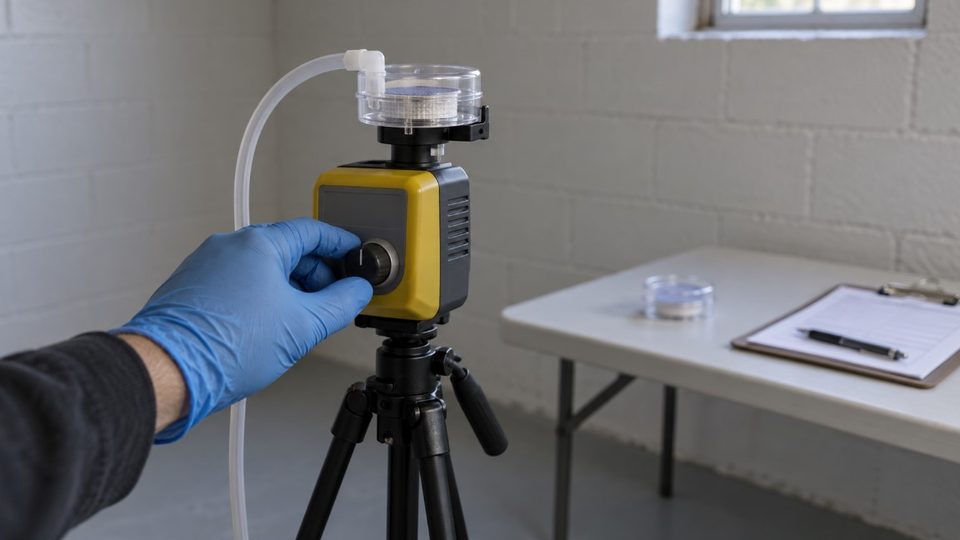
What Testing Can and Cannot Tell You
Testing produces numbers. Numbers are useful when you need to convince somebody else — a landlord, a seller, an insurer, a court — or when you cannot find a source and need a direction to look in. Numbers are not useful when you can already see the growth and know what wet it, because no laboratory result changes what has to happen next.
It is also worth being clear about what does not exist. There is no federal or Wisconsin standard for an acceptable indoor mold level. The EPA publishes no numerical threshold, and neither does the state. Any report that declares a result "passing" against a published limit is inventing the limit. What a competent report does instead is compare indoor samples against an outdoor control taken the same day, and interpret the difference.
Do you actually need a test?
Tell us what question you are trying to answer — a landlord dispute, a purchase, a clearance, a health worry. If sampling will not answer it, we will say so before you spend anything.
(608) 724-1919Free phone consultation.
Methods, and When Each Is Appropriate
| Method | Answers | Use it when |
|---|---|---|
| Air sampling (spore trap) | What is airborne, by type and concentration, against an outdoor baseline | Symptoms with no visible source; documentation; clearance. |
| Outdoor control sample | What the ambient background is that day | Always. An indoor number without it is uninterpretable. |
| Surface swab or tape lift | What a specific visible growth is | Identification of something you can see, usually for a record. |
| Wall cavity sample | What is inside a cavity, through a small hole | Suspected concealed growth where opening the wall is premature. |
| Bulk sample | What is in or on a piece of removed material | Rare in housing. Occasionally for disputes. |
| ERMI / dust DNA panels | A dust-based index score | Research tools. The EPA does not recommend them for clearance or for routine homeowner decisions. |
Spore counts swing with the weather, the season, whether a door was open, and whether anyone walked across the carpet ten minutes earlier. A single indoor sample with no outdoor control, taken once, is close to meaningless. If the result is going to be used in a dispute, the methodology matters more than the number.
What a Report Should Contain
- Sample locations, named and mapped, with the date and time of each
- An outdoor control taken the same day, in the same weather
- The laboratory, and its accreditation
- Raw counts by genus, not only a total
- Indoor-to-outdoor comparison, which is the actual finding
- A written interpretation in plain language
- What the sampler observed, including moisture readings
Getting the Sampling Right
Most of the value in a test is decided before the lab sees anything. Four things determine whether the result means anything at all.
Conditions on the day
The building should be in normal closed condition — windows and exterior doors shut for a period beforehand, the HVAC running as it normally would. Sampling with a door propped open dilutes the indoor air and produces a reassuring result that describes nothing. Avoid sampling during or immediately after heavy rain or high wind if you can, because the outdoor baseline moves sharply.
The outdoor control
Taken the same day, at the same time, upwind of the building and away from obvious sources like a compost heap or freshly cut grass. This is not optional and it is not a formality: indoor spore counts are meaningless without it, because ambient levels vary by an order of magnitude with season and weather.
How many indoor samples
Two as a minimum for a small residential job — typically the area of concern and a comparison room. More where the building is large, where there are several complaint areas, or where a specific cavity is in question. One indoor sample and no control is the configuration to refuse.
Documentation the lab needs
Each cassette labeled with location, time, pump flow rate and total volume sampled. A chain of custody form travelling with the samples. Those two details are what make a result defensible if it is ever used in a dispute, and they are the first things an opposing expert looks at.
Reading the Result Without Overreading It
The finding is the comparison, not the number.
| Pattern | Usual meaning |
|---|---|
| Indoor counts similar to or below outdoor, similar mix of genera | Normal. The indoor air reflects the outdoor air, which is what it should do. |
| Indoor higher than outdoor, same genera | Possible amplification, or simply dust disturbance. Look at the building. |
| A genus elevated indoors that is scarce outdoors | The strongest indicator of an indoor source. Worth pursuing. |
| Stachybotrys, Chaetomium or Ulocladium indoors in any quantity | These need sustained wetting. Their presence indoors points at a long-term water problem. |
| Very low counts everywhere including outdoors | Often a winter sample. Snow cover suppresses the outdoor baseline, which can flatter an indoor result. |
That last row matters here. A test taken in January with snow on the ground has an artificially low outdoor control, which makes a mediocre indoor result look acceptable. If a winter test is the basis of a decision, say so and interpret accordingly.
Clearance Testing Is a Different Job
Testing at the end of a remediation has a specific purpose: to establish that the work succeeded before the walls are closed. It has three parts, in order — a visual inspection, which is a pass or fail gate on its own; moisture verification to a documented target; and air sampling against an outdoor control. Skipping the visual and going straight to air sampling is common and wrong, because a visibly incomplete job can still produce acceptable air numbers on a quiet day.
Clearance should be performed by somebody who did not do the remediation. See post-remediation verification for why that independence matters more in Wisconsin than in states that license the trade.
Frequently Asked Questions
An air sampling package with two indoor samples and an outdoor control runs roughly $250 to $550 in this market, including laboratory analysis. Surface swabs are typically $50 to $150 each. Independent clearance testing after remediation runs $400 to $900 because it includes the visual inspection and moisture verification, not only the samples. Testing bundled into an inspection visit costs less than a separate trip.
No, and this is the single most misunderstood thing about testing. Neither the EPA nor the State of Wisconsin publishes a numerical threshold for indoor mold, because the relationship between spore counts and health effects is not consistent enough to set one. A report that says your result is “within acceptable limits” is comparing against a standard that does not exist. What a real interpretation does is compare your indoor samples to the outdoor control from the same day and describe the difference.
The settle-plate kits are close to useless for deciding anything. They will grow something in nearly any building, including a perfectly healthy one, because mold spores are present in all outdoor and most indoor air. What they cannot do is tell you concentration, compare against outdoor conditions, or tell you where the water is. If you need a number you can rely on, you need a sampler, a pump and an accredited lab. If you do not need a number, the kit answers a question you did not have.
Test if the general inspection flags moisture, if the basement is finished, if the property sits low near the Rock River, if it has been vacant, or if anyone in the household has asthma. Otherwise an inspection without sampling is usually the better purchase. What you should test for regardless is radon — Rock County is an EPA Zone 1 county, roughly half of tested homes come back at or above the action level, and the test is inexpensive.
Go back to the building, not to another test. A high indoor count relative to outdoors means there is an amplification site somewhere; it does not tell you where. The next step is a moisture investigation, not a second sample. If the first report did not include moisture readings and an interpretation, that is the gap to fill.