Removal Is Not Cleaning
The distinction matters because it is where most of the price difference between quotes comes from. Cleaning treats a surface. Remediation removes contaminated material, controls the air while it is being removed, dries the structure to a measured target, and proves the result. A quote that covers only the first is not a cheaper version of the second; it is a different and much smaller job.
The governing document is the IICRC S520 standard, which is built around physical removal rather than treatment. That is deliberate: dead spores and fungal fragments remain allergenic, so killing an organism is not the same as getting rid of it. Any method sold on the basis that it kills mold without removing the material it is growing on is answering the wrong question.
Get a scope before you get a price
Describe what is affected and roughly how long it has been wet. You will get a straight read on what has to come out, what can be dried and kept, and what the work should cost around here.
(608) 724-1919Free phone consultation.
The Seven Stages
- Correct the moisture sourceBefore anything else, and sometimes weeks before. Remediating into an active leak is money spent on a rehearsal.
- Assess and classify the extentHow much material, how wet, how long, and what category of water was involved. This sets the containment level.
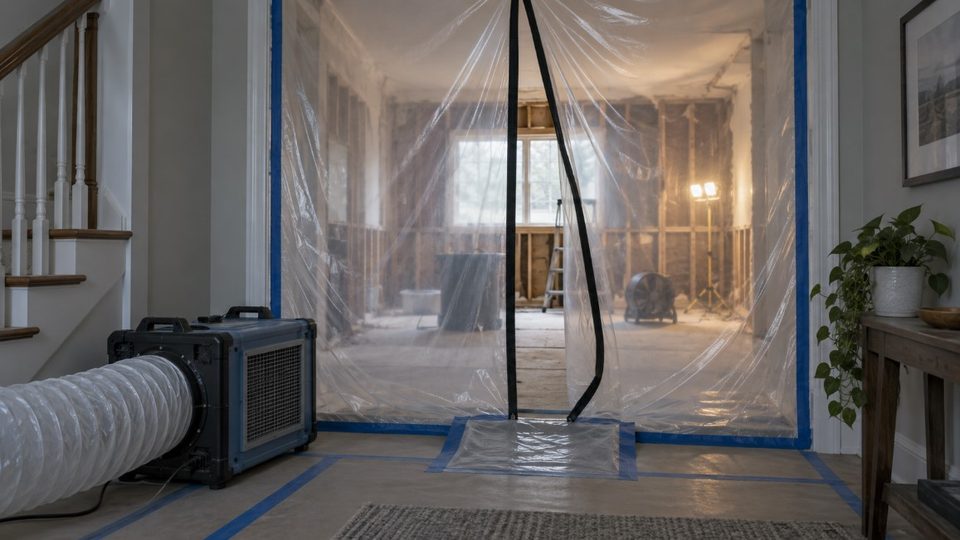
- Containment and negative airSealed barriers, a zippered entry, and a HEPA-filtered negative air machine exhausting outside so the work area is at lower pressure than the rest of the building.
- Remove contaminated porous materialDrywall, insulation, carpet, pad, ceiling tile, and anything else that has been wet long enough to colonize. Cut lines are set past the wet area, not at the edge of the stain.
- Clean what remainsHEPA vacuum, then detergent clean structural surfaces, then HEPA vacuum again. Treatment after cleaning where warranted, never instead of it.
- Dry to a documented targetAir movers and dehumidification, with daily moisture readings logged against a target derived from an unaffected reference area. In a Wisconsin winter this takes longer than people expect.
- Independent verificationVisual, then moisture, then air against an outdoor control. By somebody who did not do the work.
Not dry to the touch, and not dry because the fans have run for three days. Dry means the moisture content of the material has come back to match an unaffected reference area of the same material in the same building, measured with a meter and written down. Without that number, "we dried it" is an opinion.
What Comes Out and What Stays
| Material | Usual outcome | Why |
|---|---|---|
| Drywall, wet more than 48 hours | Removed | Paper facing is cellulose; the gypsum core wicks and holds. |
| Fiberglass batt insulation | Removed | Holds water against whatever it touches and cannot be cleaned in place. |
| Carpet and pad | Pad removed; carpet depends on the water category | Pad is a sponge. Clean water and fast response can save carpet. |
| Solid framing lumber | Cleaned and dried | Non-porous enough to clean if it is structurally sound. |
| Plywood and OSB sheathing | Usually cleaned; removed if delaminated | Surface growth cleans; delamination means it is finished. |
| Concrete and masonry | Cleaned | Non-porous at the scale that matters. The growth is on it, not in it. |
| Ceiling tile | Removed | Highly porous, and cheap to replace. |
| Contents — books, textiles, paper | Case by case | Often salvageable with specialist cleaning, often not worth the cost. |
Containment, by Scale of Job
Containment is not one thing. The level should match the size and the category of the work, and a quote should say which is being used.
| Scale | Containment | Typical situation |
|---|---|---|
| Small — under about 10 sq ft | Localised. Dust suppression, HEPA vacuum, bagged removal. Often homeowner territory. | A wall section, a closet |
| Medium — roughly 10 to 100 sq ft | Limited containment: single-layer barrier, negative pressure, sealed openings | A single room, a bathroom wall |
| Large — over about 100 sq ft | Full containment: sealed barrier, airlock entry, verified negative pressure, HVAC isolated, decontamination on exit | A finished basement, a flooded level |
| Any size, Category 3 water | Full containment regardless of area | Sewage, river flood water |
What negative pressure actually means
The work area is held at lower air pressure than the space around it, so air flows into the containment through any gap rather than out of it. A HEPA-filtered negative air machine exhausting outdoors does this. You can see it working: the sheeting pulls inward and stays there. On larger jobs the pressure differential should be recorded rather than eyeballed, and the machine should be sized to give several air changes an hour in the enclosed volume.
Why the HVAC has to be handled
A forced-air system running during remediation will take whatever is airborne in the work area and deliver it to every room in the building. Supply and return registers inside containment are sealed, and the system is either shut down or the zone isolated. In a Wisconsin winter that creates a real conflict with keeping the building warm enough to dry, which is why it should be planned rather than improvised on the day.
Antimicrobials: What They Do and Do Not Do
Applied after cleaning, to a dry surface, an EPA-registered antimicrobial treats what remains on a cleaned substrate. That is a legitimate finishing step. What it is not is a method of remediation: spraying a biocide onto contaminated material does not remove the material, and dead spores and fragments remain allergenic. The order is remove, clean, dry, then treat if warranted — never treat instead of remove. Any product used should be EPA-registered for the surface it is going on, and you are entitled to ask which one and to see the label.
The Wisconsin Basement Rebuild
Most of the finished basements we see in Rock County were built the same way: stud wall tight against cold masonry, fiberglass batts between the studs, paper-faced drywall over that, carpet on the slab. That assembly fails here reliably, because the masonry runs cold, fiberglass stops neither air nor vapor, it holds moisture against the board, and the paper facing is food.
Rebuilding the same way guarantees a repeat. The assembly that works in this climate puts rigid foam directly against the masonry — which keeps the back of the framing above dew point — then frames in front of the foam, and uses paperless board below grade. It costs somewhat more and it is the difference between fixing the problem and rescheduling it. See mold damage repair for the detail.
Frequently Asked Questions
Planning ranges for this market: a small contained area $500 to $1,500; a single room $1,200 to $3,800; a finished basement excluding reconstruction $4,000 to $12,000; an attic with cleaning, treatment and re-insulation $2,800 to $7,500. What moves the number most is how long the material has been wet, because that decides whether it is dried or removed. The cost guide breaks it down.
Usually not. Containment and negative air exist precisely so that the rest of the building stays usable while the work happens. You would normally vacate for a fogging treatment during application and the re-entry period, and it is worth considering if the work is extensive, if somebody in the household is vulnerable, or if the heating has to be off for a prolonged period in winter.
On a hard non-porous surface, bleach will remove the staining. On porous material it is close to useless and can make things worse: the chlorine stays on the surface while the water carries into the material and feeds what is below. The EPA's own guidance for household cleanup is detergent and water, followed by thorough drying. For anything under about ten square feet on a hard surface, that is genuinely all you need.
If the source material is removed and the structure is properly dried, yes, and usually within days. A musty smell that persists after remediation means one of three things: material was left in place somewhere, the drying did not reach target, or there is a second source that was never found — commonly a crawl space, a wall cavity, or the air handler. A lingering smell is information, not a nuisance.
A small contained area, a day. A single room, two to four days, most of which is drying. A finished basement, one to two weeks from strip-out to clearance. Reconstruction is separate and usually longer than the remediation itself. Anybody promising a finished basement remediation in two days is not drying the structure to a target.