How Deep the Frost Actually Goes
Southern Wisconsin building practice puts footings below the frost line, and in this part of the state that means going deeper than people who have moved here from milder places expect. A frost line is not a fixed number — it varies with snow cover, soil type and how cold a particular winter runs — but the design depth here is substantial, and that fact shapes several things about how buildings get wet.
Three consequences follow, and none of them are obvious.
Have a specific situation?
This article covers the general case. For your own building, call and describe what you are seeing. The conversation is free.
(608) 724-1919Free phone consultation.
One: Frozen Ground Cannot Absorb Meltwater
This is the big one and it explains most spring basement water in Rock County. Soil that is frozen to depth is, hydrologically, a hard surface. Snowmelt and early spring rain cannot soak into it. So the water runs across the surface to the lowest available point, which on most properties is the ground immediately beside the foundation, where the soil was disturbed during construction and has settled since.
The same rainfall in June soaks away harmlessly. In March it arrives at your foundation wall. This is why a basement can be completely dry through a wet summer and take water during an unremarkable spring thaw.
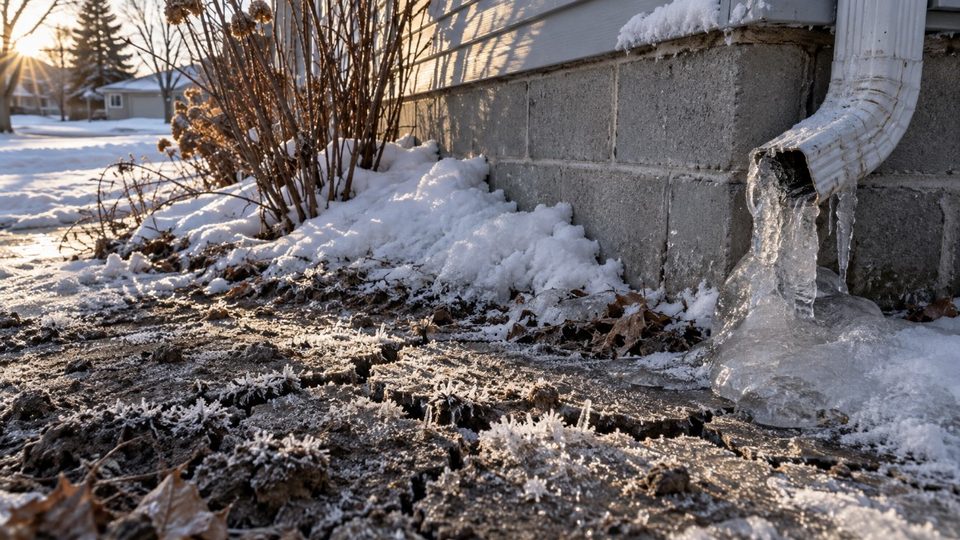
A specifically northern failure, and a serious one. When a downspout freezes at the bottom bend, the discharge backs up and comes out at the joint — directly against the foundation wall — and it does so for weeks, during the exact period when the ground cannot absorb anything. Check your downspouts during a thaw rather than in October. If water is coming out anywhere other than the end, that is your spring basement problem identified.
Two: Frost Heave Moves Things That Should Not Move
Water expands when it freezes, so saturated soil lifts. Anything founded above the frost line lifts with it and does not always come back down in the same place. In residential terms that means steps, stoops, porch piers, deck footings, garage slabs and patio slabs — none of which are always taken as deep as the house footings.
The moisture consequence is that a slab or stoop that has heaved now slopes toward the house instead of away from it, delivering water to the wall every time it rains. A surprising number of persistent basement damp problems trace back to a patio that was level when it was poured.
Three: The Cold Reaches the Rim Joist
The rim joist is the band of framing sitting on top of the foundation wall, carrying the floor above. In a deep freeze it is the coldest wood in the building: it has cold soil and cold air on the outside, and warm humid interior air on the inside, with usually nothing but a bare fiberglass batt in between.
Fiberglass stops neither air nor vapor. So warm interior air moves through it, reaches the cold framing, and condenses there. It does this for months. And essentially nobody inspects it, because it is above head height at the edge of the basement and behind insulation.
The check takes two minutes: pull back a section of batt at the coldest corner of the house and look at the wood with a flashlight. Dark staining, damp framing, or frost in midwinter all mean the same thing. Correcting it — spray foam, or cut-and-cobble rigid foam sealed at the edges — is one of the higher-value small jobs available in Wisconsin housing, and it improves comfort upstairs as a side effect.
What to Do, in Order of Value
- Downspout extensionsSix to ten feet clear of the foundation, and checked during a thaw for ice blockage. The cheapest intervention on this page and frequently the most effective.
- GradingSoil built up to fall away from the wall for the first six feet. Check it with a level rather than by eye, because settlement is gradual and the eye adapts.
- Check slabs and stoops for heaveAnything sloping back toward the house is delivering water to the wall.
- Rim joist air sealed and insulatedTwo minutes to inspect, and a genuinely worthwhile correction.
- Sump capacity and a backupSpring is when it will be tested, and spring storms cut the power.
- Keep snow piled away from the foundationA drift against the wall is a slow-release water source sitting exactly where you do not want one.
Why This Matters Before You Finish a Basement
Every item above is cheap and external. The expensive version of the same problem is discovering it after a basement has been finished, because then the water arrives behind a wall you cannot see into and the first sign is a smell eighteen months later. Anyone planning to finish a basement in Rock County should watch the space through one full spring first — not because it is likely to flood, but because spring is the season that tells you the truth about a foundation.
Questions This Article Raises Most Often
Local building practice places footings well below grade to stay under seasonal frost, and the exact design depth is set by the municipal code rather than by a rule of thumb — the building inspections office is the authority for your specific project. What matters for moisture is less the precise number and more the consequence: ground that is frozen to depth cannot absorb water, so anything that melts or falls in late winter runs across the surface to your foundation instead of soaking away.
It may well be a substantial part of it. A slab that directs water at the foundation delivers a considerable volume every time it rains, right where the soil is already disturbed and settled. Frost heave over successive winters is the usual cause of the change. The fix is either mudjacking to re-level it, or replacing it with proper fall away from the building. Either is cheaper than an interior drainage system and addresses a cause rather than a symptom.
It is worth not piling it there, which is the more common problem — shoveled snow heaped against the wall melts slowly against the foundation during every thaw. Naturally fallen snow against the wall is less of an issue and does provide some insulation to the soil. The thing genuinely worth doing in winter is checking during a thaw that the downspouts are discharging at their ends rather than at an iced-up joint next to the wall.
Roughly $800 to $2,500 for a typical house, depending on the perimeter, the access and whether any framing needs remediation before it is sealed. If it is being done as part of other basement work the marginal cost is lower because the access is already there. It is one of the few jobs in this field that improves comfort and energy use as well as solving the moisture problem, so the payback is better than the headline figure suggests.