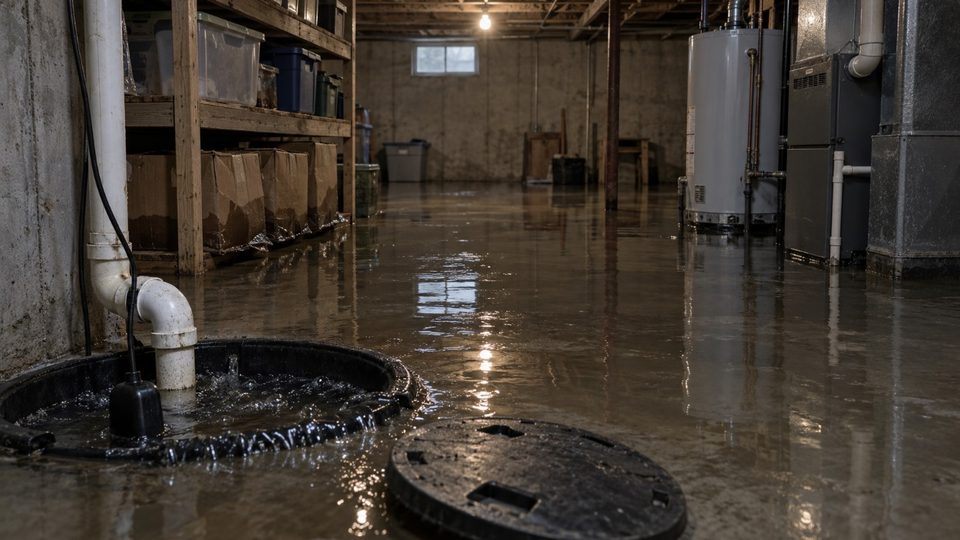
The Clock Starts When the Pump Stops
A sump pump failure is not dramatic. There is no bang, no alarm on most systems, and if it happens overnight or while the house is empty the first indication is usually the sound of water underfoot. What follows is governed almost entirely by how much time passes before somebody acts.
| Elapsed | What is happening | What it still costs |
|---|---|---|
| 0–2 hours | Water spreading across the slab, wicking into carpet pad and the base of drywall | Extraction and drying. Most material saved. |
| 2–6 hours | Drywall wicking upward by capillary action, insulation saturating, water into wall cavities | Still largely a drying job if it starts now. |
| 6–24 hours | Carpet pad fully saturated; particleboard and MDF swelling; water under the finished floor | Pad out, carpet possibly saved, drywall assessed. |
| 24–48 hours | Growth can begin on cellulose at normal temperatures | Decision shifts from drying to removal. |
| 2–7 days | Established growth on paper facings and pad; odor develops | Porous material coming out; containment needed. |
| Beyond a week | Colonization through material rather than on it; spread into cavities | Full remediation. Cost has multiplied. |
Note what this table does not say. It does not say the damage is done at 48 hours. It says the cheap option closes around then. A basement addressed on day one and the same basement addressed on day five are different jobs at very different prices.
Have a specific situation?
This article covers the general case. For your own building, call and describe what you are seeing. The conversation is free.
(608) 724-1919Free phone consultation.
Why Pumps Fail Here, Specifically
- Power cut during the storm that caused the waterThe two arrive together. This is the commonest failure in Rock County and the one a battery backup exists for.
- The pump is simply oldMost residential pumps run seven to ten years. A great many in the postwar subdivisions here are on their original or second unit.
- Overwhelmed rather than brokenOn the low ground near the river, a spring water table refills the pit faster than a pump sized for ordinary conditions can empty it.
- Stuck floatDebris, or the float catching on the pit wall or the discharge pipe. The pump is fine and never switches on.
- Frozen or blocked dischargeA discharge line that ices up in winter means the pump runs and the water comes straight back.
- Check valve failureWater in the discharge line flows back into the pit each cycle, so the pump short-cycles and burns out.
What to Do in the First Hour
- Electricity off to the affected area if water is near outlets or appliances
- Find out whether the pump has failed or is overwhelmed — is it running at all?
- Get water out: a second pump, a wet vacuum, or a hired trash pump
- Photograph everything before you move it
- Lift carpet and pull the pad — the pad is a sponge and it is what holds the water against everything else
- Pull the base of the drywall if it is wet; do not leave a wet cavity closed
- Move contents off the floor and out of the room
- Start air movement and dehumidification
A battery backup pump, or a water-powered backup if you are on municipal supply, costs a few hundred dollars. A second pump on a higher float adds redundancy for the overwhelmed case. A simple water alarm in the pit costs very little and tells you at hour one rather than hour fourteen. Against a $4,000 to $12,000 finished basement remediation, all three together are inexpensive.
Testing Your Own System
Twice a year, and it takes five minutes. Pour a bucket of water into the pit and watch. The float should rise and the pump should start promptly, run smoothly, empty the pit and shut off cleanly without cycling back on. Then go outside and confirm water is actually leaving the discharge, well away from the foundation. A pump that starts slowly, runs rough, or cycles repeatedly is telling you it is near the end. A discharge that ends two feet from the wall is simply returning the water to where it came from.
If the Basement Is Finished
The timeline above compresses, because a finished basement hides the water while it does its work. Carpet and pad hold it against the slab, the bottom plate wicks, and the drywall draws it upward behind a painted surface that looks fine. By the time anything is visible on the room side, the material behind it has been wet for considerably longer than the clock suggests. This is the argument for water alarms in a finished basement: you cannot see the floor, so something else has to tell you.
Questions This Article Raises Most Often
It means the pit is refilling as fast as it is being emptied, which in spring on low ground near the river can be normal for a period — but a pump running continuously is working at its limit with no reserve, and it will wear out faster. Two things to check: whether the check valve has failed, so the same water is returning down the discharge each cycle, and whether the discharge actually terminates well away from the house rather than soaking back in beside the foundation.
Seven to ten years for most residential units, less if it runs frequently. Age is a weaker guide than behavior: test it with a bucket twice a year and replace it when it is slow to start, runs rough, or cycles. A pump that is original to a house built in the 1980s has earned replacement regardless of whether it still works. And whatever its age, a pump with no backup is a single point of failure in a building where the failure costs five figures.
Each has a clear advantage. A battery backup works whether or not you have municipal water, but its run time is finite — typically several hours of heavy pumping — and the battery needs replacing every few years. A water-powered backup runs indefinitely with no battery to maintain, but it requires municipal water pressure and it uses a lot of water while operating, so it is not an option on a private well. On municipal supply, a water-powered unit handles a long power cut better.
Sometimes, if you get to it within hours and the water was clean. Pull the carpet and pad out — the pad is not worth saving — open the base of any wet drywall, and hire commercial air movers and a dehumidifier rather than relying on household fans. What you cannot do yourself is verify that the structure reached a documented moisture target, which is the thing that actually determines whether material stays. If the water sat overnight or came from the sump overflowing rather than from a clean supply, get it assessed.
It depends on the endorsement. Sump overflow and water backup are commonly excluded from a base homeowners policy and covered by a specific water backup endorsement, which many people do not realize they need until they need it. That endorsement is inexpensive relative to the exposure. Check your own policy schedule rather than assuming — and if you are on low ground near the Rock, check the flood position separately, because that is a different policy again.