The Short Version
A Wisconsin homeowners policy usually does not cover mold as such. It usually does cover sudden and accidental water, and mold arising from that water is often payable up to a capped limit. Long-term seepage, groundwater and surface flooding are normally excluded outright.
So the question insurers actually decide is rarely “is there mold?” It is: what was the water, and how long was it there?
Have a specific situation?
This article covers the general case. For your own building, call and describe what you are seeing. The conversation is free.
(608) 724-1919Free phone consultation.
What Is Generally Covered
- A burst supply line — the textbook covered peril
- A failed water heater, dishwasher or washing machine
- An overflowing bath or sink
- Storm damage that lets water in, such as a roof opened by wind
- Water used to extinguish a fire
- In many cases, a frozen pipe — provided the property was heated
What Is Generally Not
- Surface flooding and rising groundwater. Excluded on essentially every homeowners policy. This is the Rock River exclusion, and it catches people in Blackbridge, Riverside, Afton and Beloit every time.
- Long-term seepage. Water that has been leaking gradually, typically defined as over 14 days. The insurer's position is that this is maintenance, not an accident.
- Sump overflow and sewer backup, unless you carry the specific endorsement.
- Neglected maintenance. A roof that has been failing for years.
- Mold with no covered water event behind it — condensation, humidity, poor ventilation.
Homeowners covers sudden internal water. Flood — NFIP or private — covers rising surface water, and is a completely separate purchase. Water backup endorsement covers sump overflow and sewer backup, and is an add-on most people do not realize they lack. On low ground near the Rock, holding only the first is the common and expensive gap.
The Mold Sublimit
Even where mold is payable because it followed a covered water loss, most policies cap it. Figures in the range of $5,000 to $10,000 are common, and some policies are lower. That cap is frequently less than a finished basement remediation, which runs $4,000 to $12,000 in this market before reconstruction.
It is worth looking at your own declarations page for the mold limit specifically, rather than assuming the dwelling limit applies. Higher mold limits can usually be purchased and are inexpensive relative to the exposure.
How to Document a Claim So It Survives
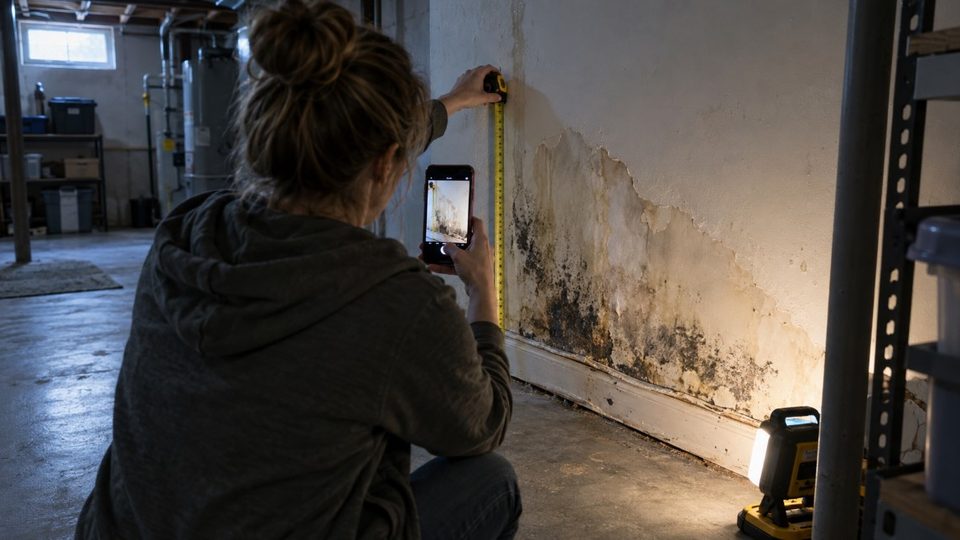
- Photograph before you move anythingWide shots and close shots, with something for scale. This is the single highest-value thing you can do and it takes four minutes.
- Report promptlyDelay is the most common reason a payable claim gets reduced. Policies require prompt notice and reserve the right to decline where delay increased the loss.
- Mitigate, and keep the receiptsYou are obliged to prevent further damage. Extraction, fans, a plumber to stop the source — all of that is usually reimbursable and all of it strengthens the claim.
- Do not dispose of evidenceKeep the failed hose, the split section of pipe, the failed pump. Photograph it in place first.
- Establish the date and the cause in writingAn inspection report identifying the source and stating when it began is worth more than a spore count.
- Keep a logEvery call, every adjuster visit, every promise, with dates and names.
Where Claims Get Denied
The three recurring reasons, in order:
Gradual rather than sudden. The adjuster concludes the leak had been running for months. This is where photographs and an inspection report establishing the onset date earn their keep.
The water was excluded. Groundwater or flood. Nothing to be done after the fact; the answer is the right policy beforehand.
Maintenance. A failure that a reasonable owner would have caught — a visibly deteriorating roof, a known leak left unaddressed.
The Endorsements That Decide Most Rock County Claims
Three optional coverages come up repeatedly in this county, and whether you have them usually matters more than any argument about the mold clause itself.
| Endorsement | What it does | Why it matters here |
|---|---|---|
| Water backup / sump overflow | Covers damage from a backed-up drain or a failed sump pump — both excluded from a standard policy | Sump failure is one of the commonest basement losses in Janesville, and the base policy does not cover it. Limits are often modest; check the number, not just the box. |
| Service line coverage | Covers the buried water or sewer line from the main to the house | Older neighborhoods with clay laterals. A collapsed lateral is otherwise entirely yours. |
| Flood insurance (NFIP or private) | Surface water from outside — the one thing no homeowner's policy covers | Rock River floodplain. Standard policies exclude this absolutely, and the 30-day waiting period means it cannot be bought when rain is forecast. |
A twenty-minute call to your agent before anything happens is worth more than any amount of argument afterwards. Ask specifically: do I have water backup, at what limit, and is my address in a mapped flood zone.
What a Claim Actually Looks Like, Week by Week
- Day oneStop the water, photograph everything before anything is moved, report the claim, and keep receipts from that hour onward. Mitigation is your duty under the policy and is separately reimbursable.
- Days one to threeEmergency mitigation begins. The drying logs start here, and they become the evidence that the loss was handled properly.
- Within the first weekThe adjuster inspects. Be present. Walk them through what was wet, not only what is still visibly wet, and hand over the photographs from day one.
- Weeks one to threeThe estimate arrives. Compare it line by line against your contractor's scope; disagreements are usually about scope rather than about coverage.
- Weeks two to sixRepairs, then the depreciation holdback is released once work is complete and invoiced — which is why the final invoices matter.
Two things people lose money on. Throwing damaged contents away before they are documented, which makes them unclaimable. And accepting a first estimate that excludes something the contractor said was necessary, without ever putting the disagreement in writing.
Whether to Claim at All
Not every loss should go through the policy. Weigh the estimated cost against your deductible, the likely effect on renewal pricing, and the fact that the claim is recorded and visible to future insurers regardless of the outcome. A $2,400 loss on a $2,000 deductible is rarely worth filing. A $14,000 basement is a different calculation entirely.
What is almost always worth doing, whichever way you go, is documenting the loss properly — because a documented, corrected water event is something you can show a buyer later, and an undocumented one becomes a disclosure problem instead. That is covered in the piece on Wisconsin seller disclosure.
Public Adjusters, and When One Is Worth It
A public adjuster works for you rather than for the insurer, and takes a percentage of the settlement. On a small, clean claim the fee is not worth it. On a large loss with a contested scope — a whole finished basement, a long-running leak, a disagreement about what has to come out — an experienced one can be worth considerably more than the fee. They are licensed in Wisconsin, so check the license, get the fee percentage in writing, and be clear that you are hiring an advocate rather than a neutral party.
If You Disagree With the Outcome
Ask for the denial in writing, citing the specific policy provision. Request a copy of the adjuster's report. You can obtain your own assessment from an independent inspector or a public adjuster, and most policies contain an appraisal clause for disputes about the amount rather than about coverage. The Wisconsin Office of the Commissioner of Insurance handles consumer complaints about insurers operating in the state.
Questions This Article Raises Most Often
Almost certainly not under a homeowners policy. Surface flooding and rising groundwater are standard exclusions everywhere in the United States, and that is precisely the water that affects properties near the Rock. Flood coverage is a separate NFIP policy or a private flood product. If you are on low ground in Blackbridge, Riverside, Afton or the Beloit riverfront, the useful action is to check now which policies you actually hold rather than at the point of a claim.
Policies require prompt notice rather than specifying a fixed number of days, which in practice means as soon as reasonably possible. Delay is the most frequent reason an otherwise payable claim is reduced, because the insurer can argue the additional damage was avoidable. Report it the same day if you can, even before you know the extent. You can always supply detail later; you cannot retrospectively make the notice prompt.
Yes, and evidence is what does it. Photographs from the day of discovery, a plumber's or inspector's written opinion on the failure mode and likely onset, and any record showing the area was dry at a known earlier date. A split from a freeze event, for instance, has a characteristic appearance and can often be tied to a specific cold snap. Ask for the denial in writing citing the exact provision, then respond to that provision specifically.
Often yes, because the water damage and the mold are usually separate line items. The structural drying, extraction and repair of the water damage may be payable under the main dwelling coverage, with only the mold remediation element subject to the sublimit. Get a scope broken down into water damage and mold components rather than a single figure — that distinction can be worth a great deal.
In this county it is worth pricing. A finished basement remediation runs $4,000 to $12,000 before reconstruction, so a $5,000 sublimit is easily exceeded. Increasing it is usually inexpensive. While you are speaking to your agent, ask about the water backup endorsement for sump and sewer, and ask directly whether you have flood cover — those are the three gaps that show up repeatedly here.