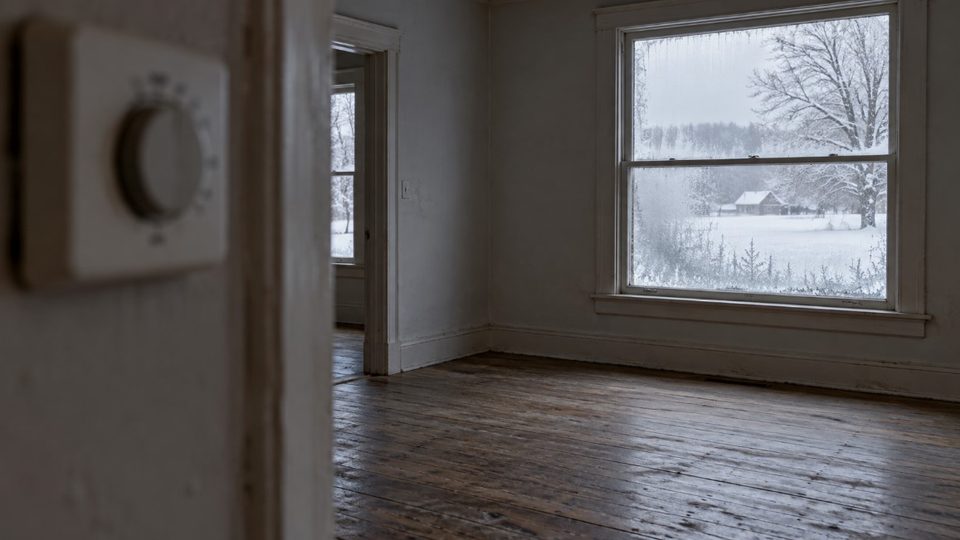
Why an Empty House Fails Differently
A house that is lived in is being managed continuously, mostly without anyone thinking about it. Doors open, extract fans run, heating cycles, somebody notices a smell or a damp patch or a dripping fitting within days. Remove the occupants and all of that stops at once.
Add the common decision to set the thermostat low — 50°F is the usual figure, chosen to protect the pipes without paying to heat an empty building — and you have created a specific and predictable set of conditions.
Have a specific situation?
This article covers the general case. For your own building, call and describe what you are seeing. The conversation is free.
(608) 724-1919Free phone consultation.
What 50 Degrees Does
The mechanism is dew point. Air can only hold so much water at a given temperature, and colder air holds less. Lower the temperature of a building and every surface in it gets closer to the point where the air touching it has to give up its moisture.
Meanwhile the moisture sources have not all gone away. Ground moisture continues to come up through the slab. Any residual damp in the structure continues to evaporate. And with nobody running extract fans, opening doors or operating a dehumidifier, none of it leaves.
The result is a building at high relative humidity with cold surfaces everywhere and no air movement — which is a fair description of the ideal conditions for mold.
1. Surface growth everywhere. On walls, ceilings, inside wardrobes and cupboards, on leather and fabric. Widespread rather than concentrated, because the cause is the whole building rather than one leak. 2. A slow leak that ran for months. Nobody was there to notice a weeping fitting or a failed water heater. 3. A frozen and split supply line. The expensive one, because the water runs continuously until somebody arrives.
The Janesville Context
This matters more here than in many places. The east side of the city carried a significant share of the disruption after the assembly plant closed at the end of 2008, and a number of properties across the area went through periods of vacancy, minimal heating or slow turnover in the years that followed. Houses near the river are also frequently held as seasonal or second properties.
If you are buying, inheriting, or taking over the management of a property that has been through that, it changes what is worth checking first — and it is genuinely useful information to mention at the start of a call, because it is not something an inspection will necessarily tell you.
Closing a Building Up Properly
Two workable approaches, and one common middle course that causes most of the problems.
Option A: keep it conditioned
- Heat to at least 55°F, and higher if the building is damp
- A dehumidifier on a humidistat, plumbed to a drain, set around 50 percent
- Interior doors and wardrobe doors left open so air can move
- Furniture pulled away from exterior walls
- Somebody checking it monthly, and actually going into the basement
Option B: winterize it fully
- Water off at the main and the system drained
- Traps protected with antifreeze
- Water heater drained
- Heating system shut down properly rather than just turned down
- A dehumidifier still worth running if power remains connected
The middle course that fails
Thermostat at 50°F, water still on, no dehumidification, nobody visiting. That combination gives you cold surfaces, high humidity, still air, and a live plumbing system in a building where a split line will run undetected for as long as it takes somebody to arrive. It is the default because it feels prudent, and it is the version that produces the problems.
Taking Over a Property That Has Been Empty
- Every plumbing run in an exterior wall or unheated spaceFor splits that may already have run. Look for staining below, not just at the pipe.
- The basement and any crawl spaceStanding water, staining, and a hygrometer left in place for two weeks rather than a single reading.
- The rim joistPull back the insulation at the coldest corner.
- Behind and under every applianceWater heater base, washer connections, under the sinks.
- The atticFor condensation staining from a building that was cold but still humid.
- Inside wardrobes and closed cupboardsWhere air moved least, growth appears first.
- Then run the house normally for a month before deciding anythingHeating, ventilation and dehumidification will resolve a surprising amount on their own, and what remains is the real problem.
Questions This Article Raises Most Often
At least 55°F if you are keeping the water on, and higher if the building is known to be damp. The common 50°F setting is chosen to protect pipes and does that adequately in most conditions, but it leaves every surface cold enough to condense. If cost is the driver, the better saving is to winterize fully — water off and drained — rather than to heat marginally. Half measures are what produce the problems.
It is the single most effective thing you can leave running, provided it is plumbed to a drain so nobody has to empty it. Set it around 50 percent on a humidistat and it will run only when needed. Against the cost of remediating widespread surface growth across a whole building — which is what an unmanaged empty house produces — the electricity is trivial.
That is characteristic of the whole-building humidity problem rather than a leak, and it is relatively good news. Fabric, leather and paper are hygroscopic and colonize before painted plaster does, so they act as the early warning. Deal with the building conditions — heat, air movement, dehumidification — and have the contents assessed separately. Hard goods usually clean; soft furnishings and books that have been in contact are often not economic to treat.
Worth checking rather than worried. Two unmanaged winters is long enough for surface growth to establish and for an undetected leak to have done real damage, but neither is certain. Put a hygrometer in the basement for a couple of weeks, check every plumbing run in an exterior wall, and look in the attic for condensation staining. Then run the house normally for a month. Anything still present after that is worth a proper moisture survey.
Frequently not, and this catches people out badly. Most standard homeowners policies restrict or exclude cover once a property has been unoccupied beyond a stated period — commonly 30 or 60 days — and a burst pipe in an unoccupied house may not be payable at all. If a property is going to stand empty, tell your insurer and ask specifically about unoccupancy terms. A vacant property endorsement costs money; an unpayable claim costs considerably more.