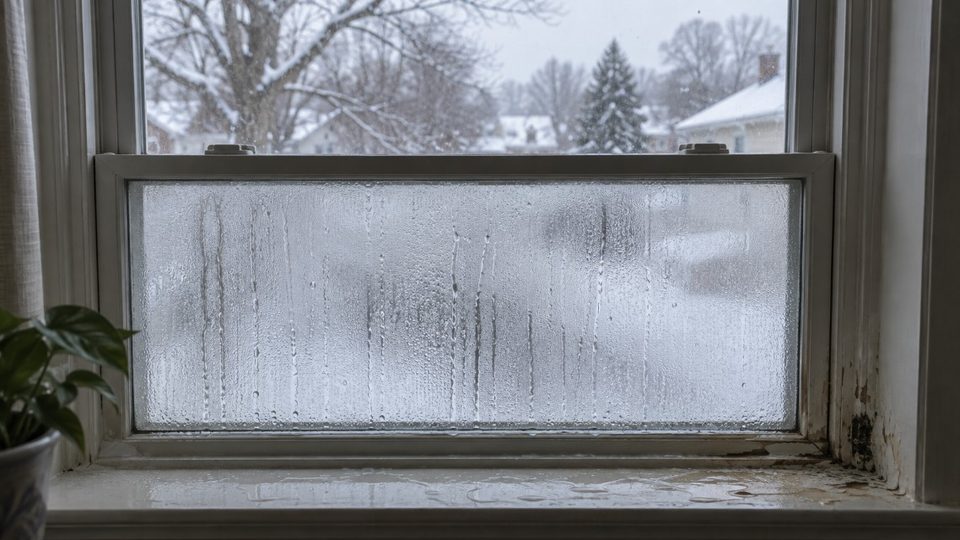
The Glass Is a Gauge, Not a Fault
Condensation on the inside of a window on a cold morning is not usually a sign that the window has failed. It is a measurement. The glass is the coldest interior surface in the room, so it is the first place where the air gives up its water — which makes it a free, continuously updating readout of whether your indoor humidity is appropriate for the outdoor temperature.
That matters because the same air is in contact with other cold surfaces you cannot see: the back of the exterior sheathing, the corners of exterior walls behind furniture, the top plate below an eave. If it is condensing on the glass, it is condensing in those places too. The window is simply where you get to watch it happen.
Have a specific situation?
This article covers the general case. For your own building, call and describe what you are seeing. The conversation is free.
(608) 724-1919Free phone consultation.
The Numbers
Indoor humidity has to come down as the outdoor temperature falls. This is the part most people are never told, and it is why a setting that was comfortable in November causes streaming windows in January.
| Outdoor temperature | Maximum indoor RH |
|---|---|
| +20°F and above | 35–40% |
| +10°F to +20°F | 30–35% |
| 0°F to +10°F | 25–30% |
| −10°F to 0°F | 20–25% |
| Below −10°F | 15–20% |
These are guidance figures rather than rules, and they assume reasonably modern double glazing. With single glazing or older units the tolerances are tighter, because the glass runs colder.
When It Stops Being Cosmetic
A light misting at the very bottom edge of the glass on the coldest mornings, clearing by mid-morning, is normal and harmless. It becomes a problem when:
- Water runs down and pools on the sill, where the paint film holds it against the wood
- The sill paint is blistering, or the wood is soft when pressed at the corners
- There is black speckling in the corners of the frame or along the sealant line
- It is not clearing by the afternoon
- The wall beside the window is damp, or the plaster is discolored
- You see it on several windows across the house rather than one
That last point matters diagnostically. Condensation on one window in one room usually means something local — a bathroom, a bedroom with the door closed and two people breathing in it, a plant collection. Condensation across the whole house means the building humidity is too high, and that is a ventilation and moisture-source question.
Where the Moisture Is Coming From
- A furnace humidifier set too highThe most common single cause in this housing, and the easiest to fix. Turn it down, and off by March.
- Showers and cooking without working extractTwenty minutes of extract after a shower, terminating outside. A timer switch removes the human variable.
- Drying clothes indoorsA load of washing puts several liters of water into the air. On a rack in a closed room in January, that goes onto the windows and into the walls.
- An unsealed or damp basement or crawl spaceStack effect carries that moisture up through the house. This is the one people never suspect.
- A disconnected or leaking dryer ventSeveral liters per load, delivered into the building instead of outside.
- Simply too little ventilation in a tight houseNewer construction with no working HRV or ERV.
Fixes, in the Order Worth Trying Them
| Step | Typical cost | What it addresses |
|---|---|---|
| Run the bath and kitchen fans properly, on a timer | $0 to $150 | The largest single moisture input in most houses, and the cheapest to correct |
| Cover the crawl space or basement floor with sealed poly | $200 to $1,200 | Ground moisture evaporating into the house, which is invisible and continuous |
| Stop drying laundry indoors; check the dryer duct actually discharges outside | $0 to $200 | Several pints a load, straight into the air |
| Reduce humidifier output, or turn it off and re-check after a week | $0 | A whole-house humidifier set for comfort will beat every other measure you take |
| Insulated cellular blinds left open at night, or moved off the glass | varies | Heavy drapes make condensation worse by keeping warm air off the glass while the glass stays cold |
| Add balanced ventilation — an HRV, or a timed exhaust strategy | $1,500 to $4,000 | A tight modern house with no deliberate air exchange. This is the real fix for that case. |
| Replace the windows | most expensive | Raises the glass temperature, so condensation stops appearing. Worth knowing what that means — see below. |
Why new windows can move the problem rather than solve it
Condensation forms on the coldest surface in the room, and in most Wisconsin houses that is the glass. Replace single glazing with a modern warm-edge unit and the glass is no longer the coldest surface — so the water stops appearing there. The moisture in the air, however, is unchanged. It now condenses on whatever is next coldest: the window frame, the corner of an exterior wall behind furniture, the top plate of a poorly insulated wall, or the back of a closet on an outside corner.
Those are all places where condensation does damage quietly, out of sight, instead of visibly on a pane you wipe every morning. This is the single most useful thing to understand about window condensation: the glass was reporting a humidity problem, and removing the gauge does not fix the thing it was measuring. If you are replacing windows in a house that runs damp, deal with the humidity at the same time.
Between the Panes Is a Different Problem
Condensation between the two panes of a sealed unit is not a humidity question at all — the seal has failed and the insulating gas has been replaced with outside air. You cannot wipe it off and you cannot fix it by changing how you live. The unit needs replacing, though the frame usually does not. It is worth knowing the difference before spending money on the wrong thing.
Storm Windows on Older Houses
On the older housing in Janesville, Edgerton and Evansville, original single-glazed windows will run with condensation in any Wisconsin winter, at almost any reasonable indoor humidity. Storm windows are the traditional and effective answer: they add an insulating air gap, which raises the temperature of the inner glass and moves it above the dew point for most conditions. That is usually a better investment than replacement, keeps the original joinery, and costs considerably less.
Questions This Article Raises Most Often
Yes, in the short term, because standing water on a wooden sill will rot it and the paint film holds the water against the framing rather than letting it dry. But treat wiping as damage limitation rather than a solution — if you are doing it daily, the indoor humidity is too high for the weather, and the same moisture is condensing inside your wall cavities where nobody is wiping anything.
This is common and is not a defect. Old leaky windows ventilated the house continuously, which kept indoor humidity low as a side effect of being drafty. Replacing them removed that unintended ventilation without adding any deliberate ventilation to replace it, so the humidity that was previously escaping now stays in and lands on the coldest surface — which is still the glass, just less cold than before. The answer is ventilation and humidity control, not the windows.
It is usually surface mold or Aureobasidium on silicone that has been repeatedly wetted, and it is a cleaning and humidity matter rather than a remediation one. Clean it with detergent and water. If the silicone is colonized through rather than just filmed on the surface, cut it out and replace it — cleaning colonized sealant does not hold, which is why it looks clean for two weeks and then returns.
Set it against the outdoor temperature rather than to one figure for the winter. Around 30 to 35 percent at 0 to 20°F, down to 25 percent or lower in a deep cold snap, and switched off entirely once spring arrives. The simplest practical rule: if there is persistent condensation on the inside of the glass on a cold morning, turn it down until there is not. Your windows will calibrate the setting better than any table.