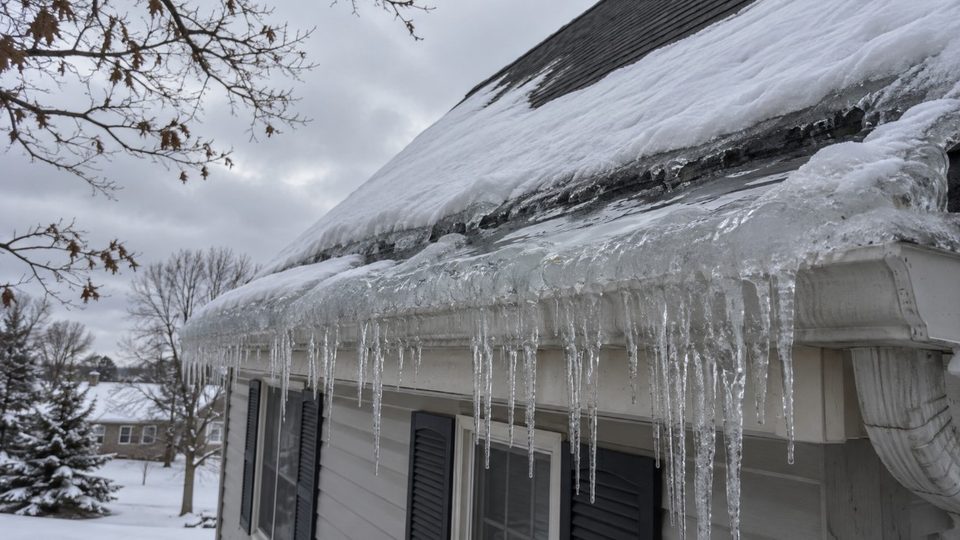
An Ice Dam Is a Heat Problem, Not a Roof Problem
The sequence is always the same. Heat escapes from the house into the attic. That heat warms the underside of the roof deck. Snow lying on the warmed part of the roof melts, even though the air temperature is well below freezing. The meltwater runs down the roof until it reaches the eave — which overhangs the wall and is therefore not warmed from below — where it refreezes.
Repeat that over a few days and you build a ridge of ice at the eave. Subsequent meltwater pools behind it, and because shingles are designed to shed water running downhill rather than to hold standing water, it works its way back up under them.
From there it enters the structure: the top plate of the exterior wall, the wall cavity beneath, the ceiling below, and sometimes the soffit. And all of that is happening in February.
Water that entered the top plate in February takes months to work through plaster, paint and insulation to a surface you can see. So the stain on the upstairs ceiling appears in June or July, by which time the ice is long gone and the obvious suspects are summer ones. Homeowners go looking for a roof leak, find nothing, and conclude it must be condensation. It is neither — it is last winter.
Have a specific situation?
This article covers the general case. For your own building, call and describe what you are seeing. The conversation is free.
(608) 724-1919Free phone consultation.
The Real Causes, in Order
- Air leakage through the ceiling planeWarm air escaping into the attic is the primary heat source warming the roof deck. Recessed lights, the attic hatch, penetrations, the tops of interior walls. Fix this and you have fixed most of the ice dam.
- Insufficient insulation depthConductive heat loss through the ceiling. Secondary to air leakage but real.
- Blocked or absent soffit intakeVentilation is what keeps the roof deck cold and even. Buried soffits mean no air movement, so the deck warms unevenly.
- Ducts and air handlers in the atticLeaky heating ducts running through a cold attic deliver heat exactly where you do not want it.
- Complex roof geometryValleys, dormers and low-slope sections collect snow and drain slowly. Not fixable, but it tells you where to expect problems.
What It Does Beyond the Stain
- Wets the top plate and the wall cavity below. This is the mold problem. The cavity is closed, insulated and dark, and it stays damp for weeks.
- Saturates ceiling insulation, which then performs worse, which increases heat loss, which makes next winter's dam bigger.
- Backs into the soffit, rotting the fascia and soffit boards.
- Lifts and damages shingles as the ice expands under them.
- Loads the gutter — ice is heavy, and gutters pull away from the fascia.
What Does Not Fix It
Worth naming, because all of these are sold.
- A new roof. New shingles shed water no better than old ones when water is sitting still behind an ice dam. Re-roofing frequently makes things worse by adding a ridge vent without correcting the intake.
- Heat cables in the gutter. They melt a channel through the ice, which is genuinely useful as damage limitation on a building where the underlying fix is impractical. They do not address why the roof is warm, and they use electricity all winter.
- Chipping the ice off. Understandable in an emergency, and a reliable way to damage shingles and gutters. If you must clear something, rake the snow off the lower few feet of roof before it melts.
- More attic ventilation on its own. Helps, but ventilating away heat you should not be losing in the first place is the second-best answer.
What Does Fix It
- Air seal the ceiling planeEvery penetration, the hatch, the tops of partition walls, the chimney chase. This is the intervention that actually works.
- Insulate to full depth, after sealingAnd keep it out of the soffits.
- Baffles at every rafter baySo the intake stays open when insulation is blown in.
- Balance intake and exhaustA ridge vent needs soffit intake to feed it, or it does nothing.
- Seal and insulate attic ductworkOr, better, bring it inside the envelope.
- Ice and water shield at the eavesAt the next re-roof. It does not prevent the dam; it stops the water getting in when one forms.
Check It in Winter, Not Summer
The one thing worth doing while the mechanism is active: on a cold day with snow on the roof, go up into the attic with a flashlight and look at the underside of the sheathing. Frost on the deck, damp nail points, or discolored insulation all tell you what is happening right now, and none of it will be visible in June. A ten-minute look in February is worth more than an hour of speculation in July.
Questions This Article Raises Most Often
Routinely, and it is the single most misattributed moisture pattern in Wisconsin housing. Water entering the top plate during a thaw cycle sits in the wall and ceiling assembly, and it takes months to migrate through insulation, plaster and paint to a visible surface. By the time the stain appears, the ice is gone, the roof is dry and the obvious explanations are summer ones. If the stain is high on a wall or on a ceiling near an exterior wall, and it appeared in the warm months, ice damming is the first thing to rule in or out.
They manage it rather than solve it. A cable melts a channel so meltwater has somewhere to go, which genuinely prevents damage, and on a building where the real fix is impractical — a complex roof, a cathedral ceiling, a listed structure — that is a reasonable choice. What they do not do is address why heat is reaching the roof deck, and they consume electricity every winter. If air sealing the ceiling is feasible, that is the better spend.
A common and frustrating sequence. Two things usually happen at a re-roof: a ridge vent is added because it is good practice, and nobody checks whether the soffit intakes are clear. With no intake, the ridge vent cannot move air, so the attic is less ventilated than before. If insulation was also topped up at the same time and buried the soffits, that compounds it. The shingles are not the issue; the airflow is.
Attic remediation with cleaning, treatment and re-insulation typically runs $2,800 to $7,500 in this market. Air sealing and ventilation correction are usually separate and are the part that stops it recurring, so it is worth having them priced rather than deferred. If water reached the wall cavity below, opening and remediating that is additional and is priced by the affected area.
Clearing snow from the lower three or four feet of roof with a roof rake, from the ground, before a thaw, genuinely reduces the amount of meltwater available to form a dam. It is a reasonable seasonal habit on a house with a known problem. Do it from the ground, never from a ladder in icy conditions, and do not attempt to chip existing ice — you will damage the shingles and the gutter and probably not improve the drainage.