What It Is
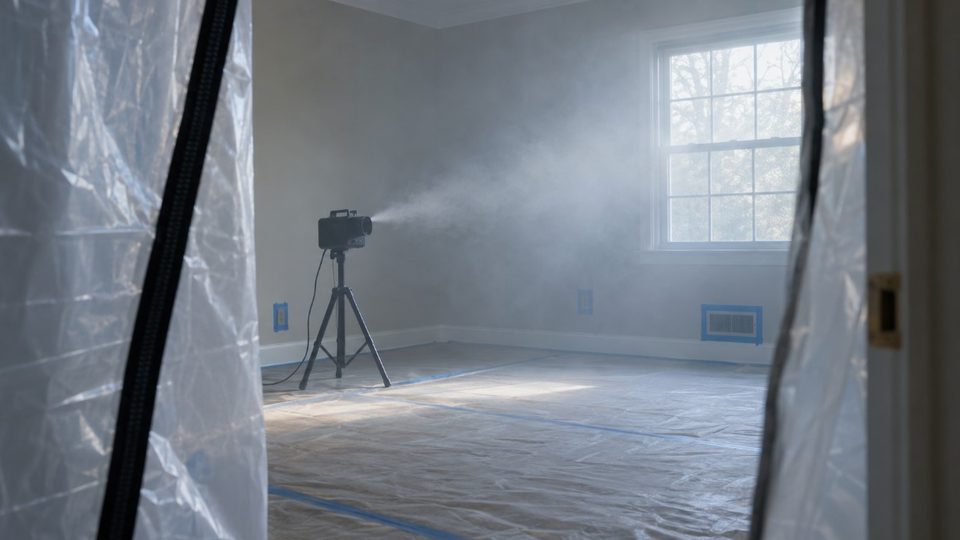
A fogging machine disperses an antimicrobial as an extremely fine aerosol — droplets small enough to remain airborne and travel into spaces a cloth cannot reach. Surfaces do not end up visibly wet, which is where the name comes from. The chemistry is usually chlorine dioxide or a hydrogen peroxide based product.
It reaches wall cavities, the backs of framing members, contents, and voids. That capability is real and it is genuinely useful in the right situation.
Have a specific situation?
This article covers the general case. For your own building, call and describe what you are seeing. The conversation is free.
(608) 724-1919Free phone consultation.
The Problem With How It Is Sold
The industry standard of care, IICRC S520, is built around physical removal of contaminated porous material. That is not arbitrary caution. Dead spores and fungal fragments remain allergenic, so killing an organism is not the same as getting rid of it. A treatment that kills what is growing on a saturated piece of drywall leaves you with a saturated piece of drywall full of dead allergenic material — and, if the moisture source is still active, a substrate ready to be recolonized.
“What porous material are you removing, and what is the fogging doing that the removal cannot?” There is a good answer to that question in legitimate applications — treating cavities, framing and contents that cannot be reached or wet-cleaned. If no good answer comes back, the fogging is doing the job of a chequebook rather than a method.
Where It Is Genuinely the Right Tool
- As a supplementary step after removal and cleaning, to treat surfaces and voids that cannot be reached mechanically
- Contents — books, textiles, electronics — that cannot be wet-cleaned
- Occupied commercial premises where extensive demolition is not viable and the contamination is surface-level
- Historic interiors where removing finishes would destroy fabric worth keeping
- Large attic and crawl space volumes after cleaning, where hand coverage is impractical
Where It Is the Wrong Tool
- Wet or water-damaged porous material is still in the building. The single biggest misuse.
- The moisture source has not been corrected. Anything that regrows will regrow on a treated surface just as readily.
- As a substitute for containment. Fogging does not prevent distribution of material during removal.
- As a substitute for clearance testing. A fogged building still has to be verified.
- As a first response to a smell. It will remove the smell temporarily, which is precisely the risk.
Practical Considerations
Occupancy. The building is vacated during treatment and for a re-entry period set by the product label, typically several hours. Pets, plants and fish out.
Preparation. Food and medications removed or sealed. HVAC handling planned — sometimes the system is run deliberately to distribute fog through the ductwork, sometimes isolated. Sensitive electronics and artwork may need protection.
Chemistry and disclosure. Ask which product and ask for the safety data sheet. Chlorine dioxide is a strong oxidizer and can affect some materials and finishes; hydrogen peroxide systems are generally gentler. Anyone unwilling to tell you what they are fogging into your house should not be fogging anything into it.
Verification. Fogging does not exempt a project from independent clearance testing, and a contractor who suggests otherwise is telling you about their standards.
The Marketing Claims, Line by Line
| The claim | What is behind it |
|---|---|
| “No demolition” | True of the fogging itself. Not true of the job, if wet porous material is present — that has to come out whatever is fogged afterwards. |
| “Kills 99.9 percent of mold” | A laboratory figure for surfaces the product reaches, on a test organism. Dead spores are still allergenic, and the figure says nothing about growth inside a material. |
| “Reaches where demolition cannot” | Genuinely true, and the strongest argument for the method. It is why it is useful on complex framing and in crawl spaces. |
| “EPA registered” | Means the antimicrobial product is registered for its labeled uses. It is not an EPA endorsement of fogging as a remediation method. |
| “One day, whole house” | Accurate for the application. A whole-house mold problem that can genuinely be resolved in a day is a whole-house problem that was mostly airborne to begin with. |
| “Cheaper than traditional remediation” | True, and it is comparing two different jobs. Cheaper than removing and rebuilding a basement, because it does not remove or rebuild anything. |
None of those is a lie. Each is a true statement doing more work than it should.
What It Does Not Do to a Wet Wall
Consider the commonest Janesville case: a finished basement where water has come through the foundation and soaked the bottom of the drywall and the batt insulation behind it. Fog that room and you get a clean-smelling room with a wet wall in it. The moisture has not moved; the insulation is still holding water against the framing; the paper facing of the drywall is still a food source; and in three weeks the growth is back on the same eighteen inches of wall.
The test is simple enough to apply yourself: if a meter reads high behind the finish, fogging is not the answer to that part of the problem. It may still be the right answer for the joists overhead.
Three Questions Before You Sign
- What is being removed, and where are the cut lines?A proposal with no removal on a job with wet porous material has skipped the part that matters.
- What are the current moisture readings?If nobody has metered, nobody knows whether row one applies.
- Who does clearance, and when?Independent verification afterwards, as with any other method. Fogging does not exempt a job from being checked.
Full detail on where the method fits in a plan is on the dry fog remediation page.
What It Costs Here
- Whole-house treatment — roughly $1,200 to $4,500, by square footage
- A single level or defined area — roughly $700 to $2,200
- Contents only — commonly $400 to $1,800, by volume or by room
The figure that should make you pause is a whole-house fog quoted well below a conventional remediation. It is cheaper because it omits the removal and reconstruction the job actually needs. That is not a discount; it is a different and smaller scope.
Prices shown are examples only. For an accurate quote for your specific situation, call (608) 724-1919 — free consultation with a specialist.
Questions This Article Raises Most Often
Legitimate as a supplementary tool, frequently mis-sold as a replacement. Both things are true and it depends entirely on the proposal in front of you. Fogging to treat cavities and contents after wet material has been removed is good practice. Fogging as the entire scope, with saturated drywall left in the wall, is not remediation regardless of what it is called. The question about what porous material is being removed distinguishes the two in one sentence.
Not by itself, and this is the trap. Fogging reliably removes odor in the short term, including when the source material is still in place. If the wet material remains, the smell typically returns as the treatment breaks down — usually within weeks to a few months. A treatment that removed the smell while leaving the cause has bought you time rather than a result. Judge it at three months, not at three days.
The products in general use are registered for the purpose and are considered safe once the space has been ventilated and the label's re-entry period observed. That period exists for a reason and should not be shortened. People with asthma or chemical sensitivity should allow longer. Pets, plants and fish leave the building. Ask for the safety data sheet — it is a routine request and any professional will have it to hand.
That is only true if nothing behind those walls is wet or contaminated — which is exactly the thing that needs establishing rather than assuming. Ask for the moisture readings that support the claim. If the readings show dry cavities and the growth is surface-level, fogging plus cleaning can be a reasonable plan. If nobody has measured anything, it is a sales position rather than a technical one.