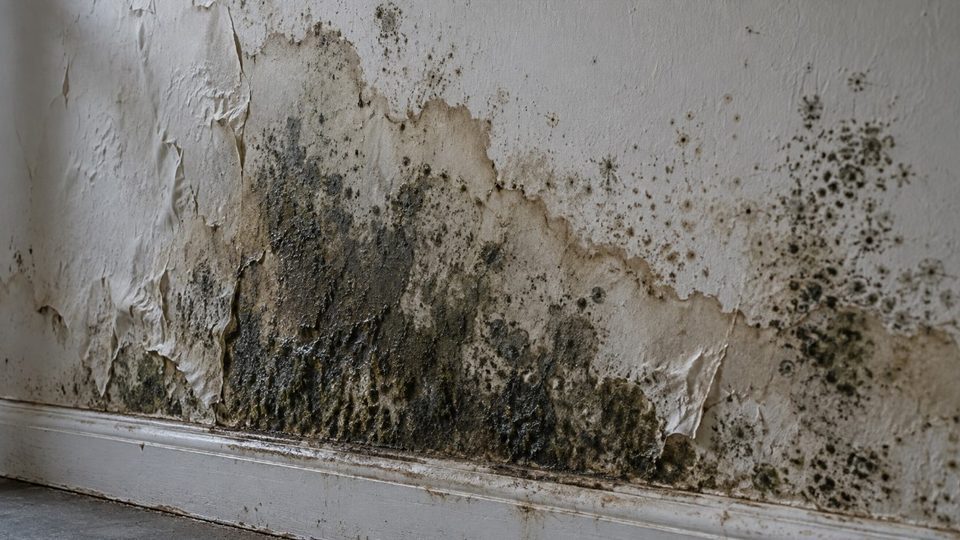
What Stachybotrys Is
Stachybotrys chartarum is a greenish-black mold that grows on very wet cellulose — drywall paper, cardboard, wood, paper-faced insulation. Its defining requirement is sustained moisture. It does not establish from a single damp weekend; it needs material that has been wet for an extended period.
That requirement is what makes it useful. Finding it is genuinely informative, because it tells you there has been a long-running water problem rather than a recent event. In that sense it is less a hazard to be feared than a piece of evidence to be read.
Have a specific situation?
This article covers the general case. For your own building, call and describe what you are seeing. The conversation is free.
(608) 724-1919Free phone consultation.
Two Corrections to the Popular Account
Black growth is not automatically Stachybotrys. A great many entirely ordinary species are dark — Cladosporium, Alternaria, Ulocladium, several Aspergillus species. Identification by eye is not possible for anyone, including people who tell you otherwise.
Stachybotrys is not always black. Depending on the substrate and how wet it is, it can appear dark green, olive, or nearly gray, and when actively wet it often looks slimy rather than fuzzy.
In the 1990s a cluster of infant pulmonary hemorrhage cases was tentatively linked to Stachybotrys exposure. That association drove a great deal of press coverage and is the origin of the “toxic black mold” framing. Subsequent investigation, including by the CDC, did not support the link, and the major evidence reviews have not found support for the severe systemic effects attributed to household exposure. The phrase outlived the finding.
What Actually Determines How Serious It Is
Six questions, none of which is about color.
- How large is the affected area?The EPA's guidance turns on square footage. Under about ten square feet on a hard surface is homeowner territory; well beyond that is not.
- What material is it on?Paper-faced drywall, cardboard and wood mean it has a food source and is likely growing into the material rather than on it. Tile and concrete do not.
- How long has it been wet?The single most predictive question, and the one that decides whether material is dried or removed.
- Is the water still arriving?Remediation into an active source is a rehearsal.
- Is it in the air handling system?That changes it from a local problem to a whole-building one.
- Is anyone in the household vulnerable?Asthma, allergy, immunosuppression. This changes urgency, not method.
Why Containment Matters
The genuine risk moment in a black mold situation is not living beside it — it is disturbing it. Established growth that is cut into, scraped or demolished releases a large quantity of spores and fragments into the air at once. That is why remediation is done under sealed containment with negative air pressure and HEPA filtration, and why the single worst thing a homeowner can do with a large area is attack it with a scrubbing brush.
Full containment means: sealed polyethylene barriers, a zippered entry, a HEPA-filtered negative air machine exhausting outside, the HVAC system isolated so nothing travels through the ductwork, bagged removal of material, and cleaning on the way out.
Finding the Water That Allowed It
Because sustained moisture is the defining requirement, Stachybotrys is nearly always a symptom of something specific. In Rock County housing the recurring causes are:
- A plumbing leak inside a wall that has been running for months or years
- Material left in place after flooding — the 2008 legacy in the river neighborhoods
- A basement that has been wet for successive springs without anyone opening the finished wall
- Ice-dam water entering the same top plate every winter
- An exhaust duct discharging into the same attic spot twice a day for years
Remediating without identifying which of those it was means scheduling the work again.
What You Can and Cannot Do Yourself
Can: under about ten square feet, on a hard non-porous surface, with detergent and water, gloves and an N95, followed by thorough drying and correction of whatever wet it. The EPA says so explicitly, and this genuinely covers a lot of household situations.
Should not: anything substantially larger, anything on porous material, anything inside a wall cavity or an HVAC system, anything where the water source is unknown, and anything at all if somebody in the house is immunocompromised. Not because the species is uniquely hazardous, but because disturbing it without containment distributes it, and because a large area means a lot of water you have not yet found.
Questions This Article Raises Most Often
Usually not. Proper containment and negative air are designed so the rest of the building remains usable while the work happens. The situations that change that: a fogging treatment, where you leave for the application and the re-entry period; very extensive work; or a household member who is immunocompromised or has poorly controlled asthma. Say at the outset if anyone is vulnerable — it changes the containment plan rather than the price.
Only if you need the record — for a landlord dispute, an insurance file, or a sale. It rarely changes the work, because the response is determined by the extent of the growth and the water history rather than by the species. A tape lift is inexpensive if you want it. What is genuinely worth paying for is the moisture investigation, because that is what stops it returning.
It is priced by affected area and containment requirements, not by species: a small contained area $500 to $1,500, a single room $1,200 to $3,800, a finished basement $4,000 to $12,000 excluding reconstruction. What tends to push a black mold job higher is that sustained moisture means more material is affected, not that the organism itself costs more to remove. Anyone charging a premium for the word is selling the word.
On a hard non-porous surface bleach will remove the staining, and detergent and water will do the same job with less risk. On porous material bleach is close to useless and can be counterproductive: the chlorine stays on the surface while the water carries into the material and feeds what is below. That is why bleached drywall looks clean for two weeks and then darkens again. EPA guidance for household cleanup is detergent and water followed by thorough drying.
Then the water is still arriving and nobody has found it. Recurrence in the same location is not a failure of the cleaning; it is a diagnostic result telling you the moisture source was never identified. The next step is a moisture investigation rather than another clean — thermal imaging, metering, and attention to the seasonal pattern of when it reappears.